
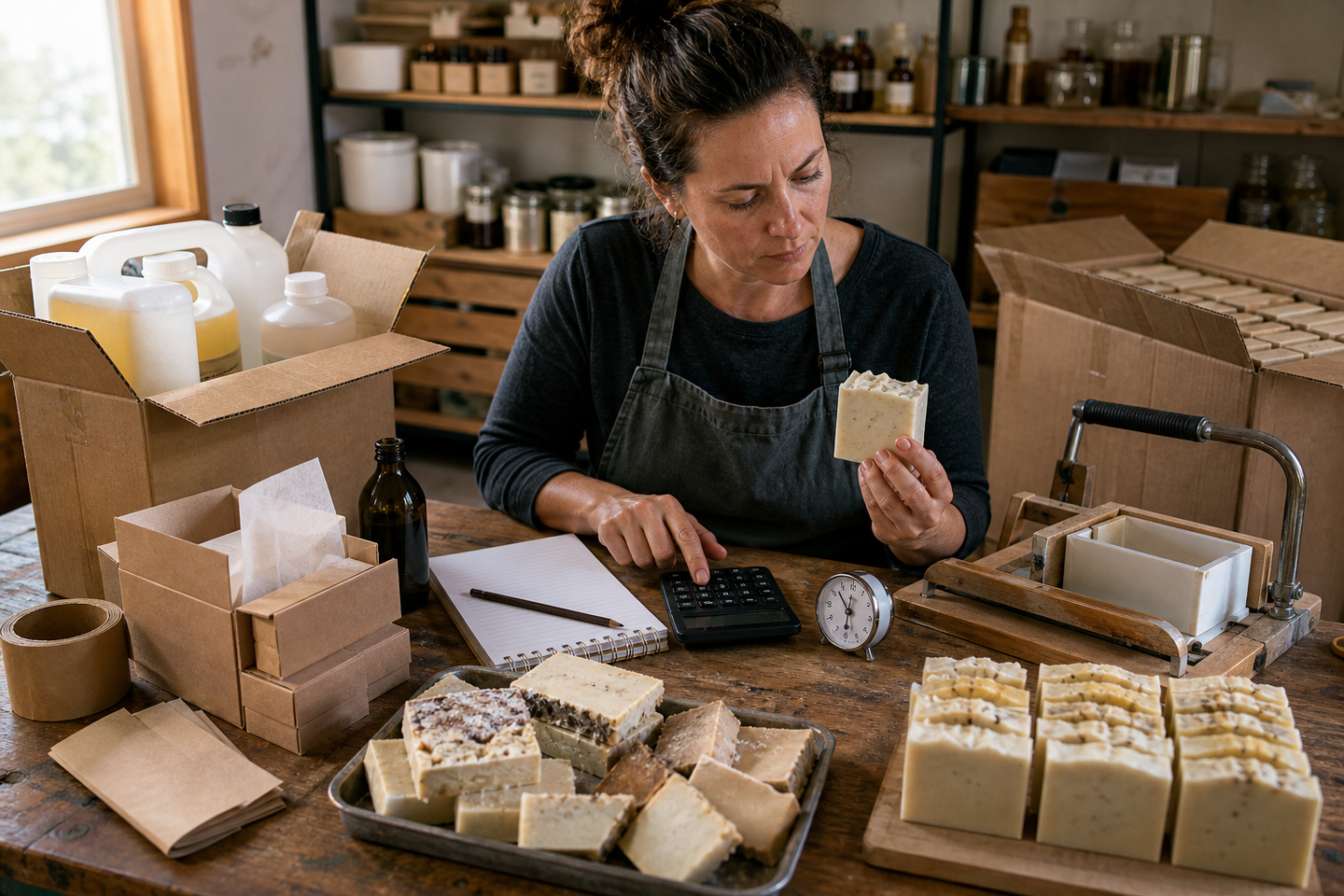
Most makers can tell you what their materials cost. Fewer can tell you what a batch costs — and almost nobody prices the four expenses below, which is why a healthy-looking margin quietly turns into a break-even year.
Take a forty-bar batch of lavender soap. The recipe calls for shea butter, olive oil, lye and lavender essential oil. Add those four up at their last purchase price and you get $50.85 — call it $1.27 a bar. That number is true, and it is also nowhere near what the batch actually cost you.
1. Freight, split properly
A 24 kg pallet of shea butter costs $355 delivered, of which $50 is freight. If you record the material at $12.71 a kilo and treat the freight as an overhead, every batch you cost is understated — and the understatement grows with every long-haul order. Landed cost is the fix: divide the freight across the units it carried, then use that number everywhere.
| Line | Amount |
|---|---|
| Invoice price, 24 kg | $305.00 |
| Freight | $50.00 |
| Landed cost per kg | $14.80 |
2. Packaging is a material
Kraft boxes, labels, tissue, the sticker you hand-cut for the market stall. Individually trivial, collectively $8.80 on a forty-bar batch — 22 cents a bar, or about 15% of your material cost. Packaging belongs in the recipe, not in a monthly overhead line you look at once a quarter.
3. The batch that failed
Every maker loses batches. Soap seizes, wax frosts, a lid warps in the post. If one batch in twenty doesn't reach a customer, your real cost per saleable unit is roughly 5% higher than your recipe says. Track scrapped runs for one season and you will have a number worth pricing against — most makers guess low.
I found out the hard way that my best-selling bar was my worst margin. It wasn't the recipe — it was the shipping box.
4. Your own hours
The cost nobody wants to write down. A forty-bar batch takes about two hours of active work plus half an hour of cleaning and admin. At even a modest $25 an hour, that is $62.50 — more than the materials. You do not have to pay yourself that today, but if the price doesn't carry it, you cannot hire the help that lets you stop making every batch yourself.
Put all four in and the lavender bar costs $2.94 to make, not $1.27. At a $4.80 wholesale price that is a 39% margin — healthy, but a long way from the 74% the recipe alone suggested. Knowing which number you are looking at is the whole job.
Where to start this week
- Re-enter your three largest materials at landed cost, freight included.
- Add packaging lines to one recipe and see what happens to the margin.
- Write down every scrapped batch for a month. Just the count.
- Pick an hourly rate for yourself. Any rate. Then cost one batch with it.
None of this requires new software. It requires the numbers to live in one place and stay attached to the batch they belong to — which is, admittedly, what we built Batchmade to do.